
CQC registered personal care provider
Supported Living in East London, Greater London, Essex and Cornwall
Support built around what a person wants to be able to do, in their own home, with their own front door and their own decisions.
- CQC Registered Provider
- Person-Centred Support Plans
- Professional Referrals Welcome
- Own Home, Own Tenancy
Your own home, with support alongside
Supported living means someone has their own home and their own tenancy, with support arranged separately around it. That separation matters more than it sounds. It means the housing does not depend on the support provider, and it means the person is a tenant with rights rather than a resident receiving a package.
In practice, it looks like ordinary life with help built in. Someone gets up when they choose, has their own key, decides who visits and what happens on a Saturday. A support worker is there for the parts that are genuinely difficult, and steps back from the parts that are not.
The purpose is not to maintain someone at a fixed level. It is to help them do more over time. That might mean cooking a full meal unaided by the spring, managing their own bills, using the bus alone, or getting through a difficult week without things unravelling. Those goals belong to the person, not to us.
Support shaped around the individual
Daily routines
Getting up, meals, sleep patterns and the structure that holds a week together, at whatever level of prompting or hands-on help is needed.
Independent living skills
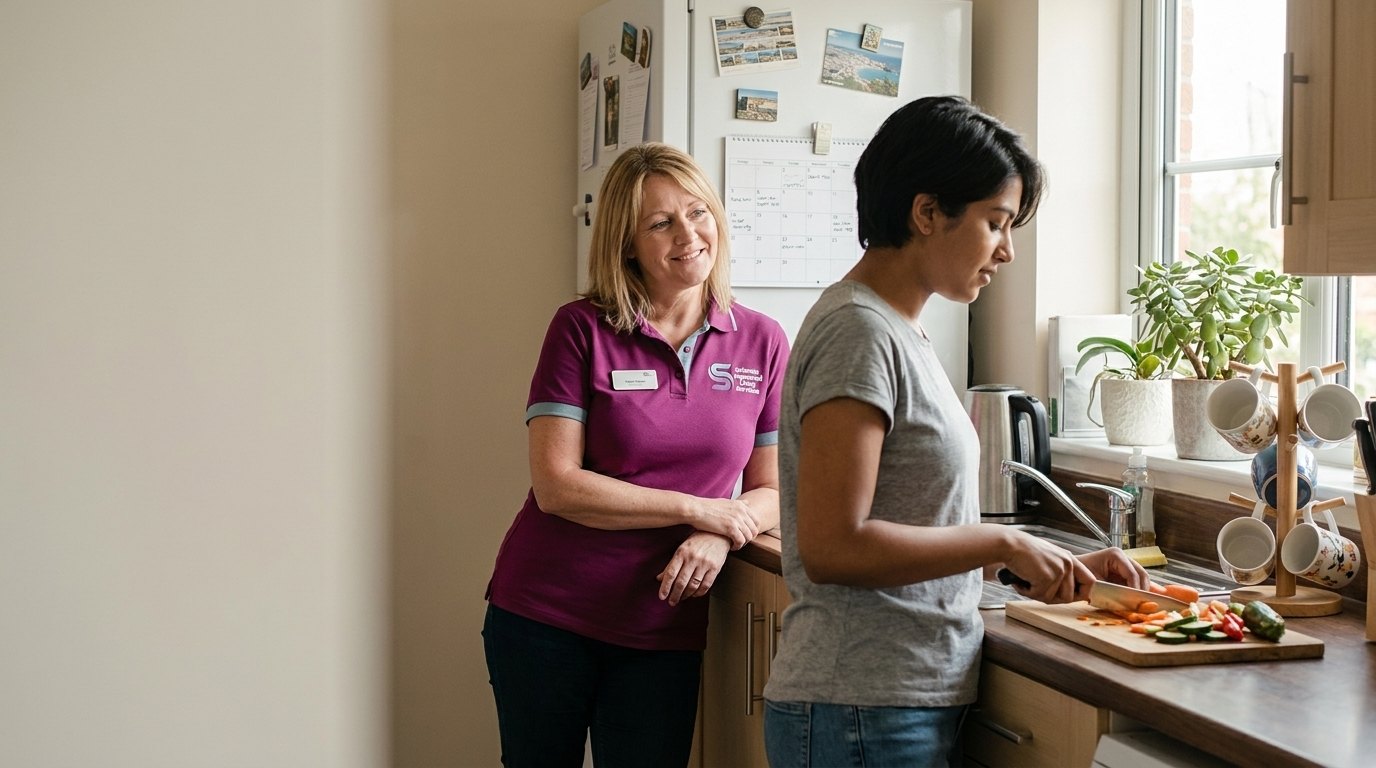
Cooking, laundry, cleaning, food shopping and keeping a home running. Taught and practised alongside someone rather than done for them.
Budgeting and money
Support with benefits, bills, budgeting and everyday spending decisions, working towards someone managing their own finances where possible.
Appointments and correspondence
Health appointments, letters, forms and phone calls that feel harder than they should.
Health and wellbeing
Attending appointments, keeping to agreed routines, and support with medication where this has been assessed and authorised within the support plan.
Personal care
Where it forms part of the assessed and agreed plan, and where it falls within our registered scope, delivered with the same privacy and dignity as anywhere else.
Community and connection
Getting to college, work, volunteering, clubs, faith groups, the gym or simply out of the flat. Isolation undoes progress faster than almost anything else.
Confidence and coping
Building the practical strategies that make a difficult day manageable, and recognising early when someone needs more support for a while.
Working with others
Coordinating with social workers, care coordinators, mental health teams, GPs, housing providers and families, with the person's consent.
Consistent with our CQC registration, we support adults including people living with mental health conditions, physical disabilities and sensory impairments.
Principles that shape the support
The person leads
Support plans are written with the individual, in their words, around goals they actually care about. A plan someone has not agreed to is a plan that will not work.
Least support that works
We aim for the lowest level of support that keeps someone safe and moving forward, and we review it as skills grow rather than leaving hours in place out of habit.
Choice is real, not decorative
Who visits, what is cooked, how the flat is arranged, what happens at the weekend. These are the person's decisions.
Consistent support workers
A small, familiar team matters here as much as anywhere. Trust takes time and restarts every time the face changes.
Cultural and religious needs
Food, faith, language, festivals and community connections are part of the plan, not an add-on.
Honest about capacity
If a referral needs more than we can safely provide, we say so at the assessment rather than accepting it and struggling. That honesty protects the person more than optimism does.
For professionals and referrers
Referrals, assessments and placements
How to refer
Referrals are accepted from social workers, care coordinators, hospital discharge teams, commissioners, housing providers, families and individuals themselves. Call our office or submit the enquiry form and mark yourself as a professional referrer.
What we need at referral
The person's assessed needs, current living situation, any risk assessments, the level of support being commissioned, funding arrangement and the timescale you are working to. Partial information is fine at first contact.
Assessment
We meet the person, review the information provided, discuss whether we can genuinely meet the need within our registered scope, and confirm either way. We will not accept a placement we cannot staff properly.
Staffing model
Support hours are agreed to the assessed need, delivered by a consistent team who receive induction, ongoing training and supervision.
Transition and moving in
Where a person is moving, we plan the transition rather than starting cold: introductions, familiarisation and a phased build-up wherever timescales allow.
Ongoing review
Support is reviewed regularly with the person and the placing authority, with progress against goals recorded and hours adjusted as independence grows.
Situations where supported living works
- A young adult moving on from the family home who needs support to manage a tenancy for the first time
- Someone leaving hospital who needs support re-establishing routines in the community
- A person living with a mental health condition who wants to live independently with support available when things are harder
- Someone with a physical disability or sensory impairment who needs practical support to run their own home
- A person whose current arrangement offers less independence than they are capable of
- Someone who has been managing alone and is struggling, but for whom residential care would remove far more independence than necessary
If you are unsure whether supported living is the right route, contact us and we will give you an honest view, including when it is not.
Why choose Safeside
Registered and accountable
Registered with the Care Quality Commission to provide personal care through homecare and supported living services.
Carefully recruited carers
Enhanced DBS checks, reference checks and right to work verification before anyone supports a single person, followed by structured induction and ongoing training.
Genuinely local
Our team knows the communities we support across East London, Greater London, Essex and Cornwall, so visit times reflect real travel rather than optimistic scheduling.
A manager you can reach
Families speak to our management team directly rather than working through a call centre.
Registered with the Care Quality Commission (CQC)
Safeside has been registered since 29 April 2025. Location ID 1-22153100025. View our CQC profile
What happens next
Speak to our team
Call us or send an enquiry. We will listen, answer your questions and explain the options honestly, including when we are not the right fit.
Free care assessment
We visit at a convenient time to understand routines, preferences, health and mobility needs. There is no charge and no obligation.
A personalised support plan
We agree a written plan covering what support is provided, when, by whom and how we will keep you informed.
Care begins and is reviewed
Support starts on the agreed date, and we review it regularly so it keeps pace with changing needs.
Request a free care assessment
Tell us a little about the person and the support you are looking for. There is no cost and no obligation.
Feedback from the people we support
Safeside is a newly registered provider, so we are at the start of building our public feedback. As reviews come in you will be able to read them on Homecare.co.uk and Google. We would rather show you nothing than show you something we made up.
View our CQC profileQuality and safeguardingRead all reviews
Where we work
We provide supported living across East London, Greater London, Essex and Cornwall. Referrers working across a wider county footprint are welcome to contact us to discuss whether we can cover a particular area.
Questions about supported living
Registered and accountable
Regulated, registered and open about it
Every mark below links to the public register or scheme, so you can check it for yourself rather than take our word for it.
 RegisteredRegistered with the Care Quality CommissionLocation ID 1-22153100025View register →
 RegisteredRegistered with the Information Commissioner's OfficeRegistration ZB036287View register →
 MemberSafety Schemes in Procurement, registered memberView register →
- SfCMemberSkills for Care, the workforce development body for adult social careView register →
Talk to Safeside about supported living
Our team is here to talk things through, whether you are ready to arrange care or just starting to look into it.